What Is Dark Romance?
Romantic fiction that goes where mainstream stories won't — into moral complexity, power, danger, and the parts of desire that don't fit neatly into daylight.
Where does your story begin?
Definition
Dark romance is a sub-genre of romantic fiction characterised by morally complex or ambiguous protagonists, unconventional power dynamics, transgressive themes (including dubious consent, obsession, captivity, or violence), and an emotional intensity that often exceeds mainstream romance. The genre does not guarantee a traditional happy ending, though it typically resolves with the central relationship intact.
What makes a romance 'dark'?
The darkness in dark romance operates on several levels simultaneously. Thematically, it explores desire in contexts that mainstream fiction avoids — obsession, captivity, moral complicity, anti-hero love interests who have done genuinely terrible things. Tonally, it is often more intense, more atmospheric, and less reassuring than conventional romance. The reader or listener is not always comfortable; that discomfort is part of the point.
Crucially, dark romance is fiction. The appeal lies in the safety of exploring these dynamics through narrative — a controlled, consensual encounter with scenarios that would be intolerable in reality. This is what psychologists call 'the paradox of fiction': we can feel genuine emotions in response to events we know are not real, and we can safely explore desires we would not want enacted in our lives.
Common tropes in dark romance
Dark romance has developed a recognisable lexicon of tropes: the 'morally grey' hero (or anti-hero) who operates outside conventional ethics; the 'dark captive' setup (two characters confined together under duress); stalker romance (an obsessive love interest whose surveillance of the protagonist is portrayed with ambivalence); and 'dark forced proximity' (situations where the power imbalance is explicit and central to the tension). These tropes are not endorsements; they are narrative scaffolding for exploring complex emotional territory. Many of these dynamics naturally pair with enemies-to-lovers structures, where the original antagonism gives the dark dynamic its credibility.
Who reads dark romance and why?
Dark romance is predominantly read by women. This is not a contradiction — it reflects the fact that women's erotic and romantic imaginations are more complex and varied than mainstream media tends to acknowledge. Research on fantasy content consistently finds that women are more likely than men to engage in fantasy scenarios involving power imbalance, even among women who hold strongly egalitarian values. Dark romance provides a literary space for that exploration.
Adult bedtime stories on The Private Story can incorporate dark romance tones and tropes at your request.
Dark romance vs paranormal romance vs romantasy
These genres overlap significantly but are distinct. Paranormal romance involves supernatural elements (vampires, werewolves, fae) but is not necessarily dark in tone — though many paranormal romances are. Romantasy (romantic fantasy) is a broader category that spans light and dark. Dark romance is defined by its tonal and thematic qualities rather than its setting — a contemporary dark romance set in a crime family is as much 'dark romance' as a fantasy novel featuring a fae king with questionable ethics.
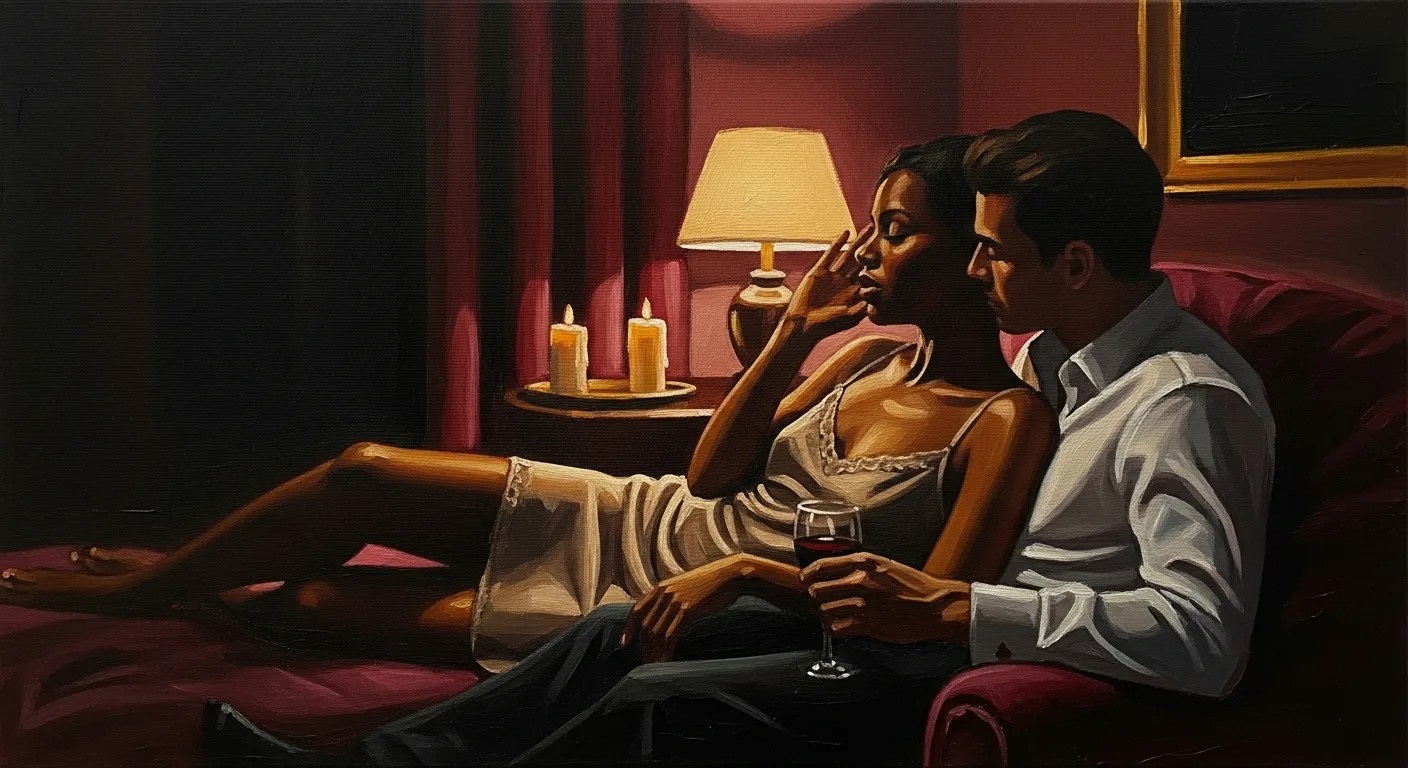
Requesting dark romance in a personalised audio story
At The Private Story, dark romance is a fully supported genre. When you create your brief, you can specify morally grey characters, power imbalances, specific dark tropes, and content intensity. The story will be constructed around your preferences — including explicit content if requested. All content, including dark themes, depicts fictional adults and is handled with narrative craft rather than gratuitousness.
Explore personalised erotica to understand how explicit dark romance stories are created, or create your own dark romance story in under two minutes.
Content warnings in dark romance — what they mean
Dark romance communities have developed a detailed vocabulary of content warnings — sometimes called CWs or TWs (trigger warnings) — that alert readers and listeners to specific content before they engage. Common dark romance content warnings include: dubious consent (also written as dub-con), non-consent (non-con), obsessive or stalker behaviour, violence, captivity, morally grey or villain protagonists, and graphic explicit content.
These warnings are not critiques of the genre; they are tools that allow readers to make informed choices about what they engage with. A listener who finds obsession narratives cathartic and engaging will seek them out. A listener who finds non-consensual scenarios distressing can avoid them. At The Private Story, the intensity and trope choices you make in the Casting Room serve the same function: you shape the parameters of what the story will and will not include before it is written.
Dark romance in audio — the specific power of narrated darkness
Dark romance translates particularly well to audio for one specific reason: narration makes interiority visceral. The reader of a dark romance novel experiences the protagonist's internal experience through text — words on a page that describe fear, desire, confusion. The listener of a dark romance audio story hears those same interior states in a voice. The narrator's breath, the pace of delivery, the warmth or edge in their tone — all of this transforms the written interiority into something felt.
A morally grey love interest reads differently from the page than he sounds when narrated. A captivity scenario unfolds differently when the listener cannot skip ahead, when the tension has duration, when the narrator's voice inhabits both characters with the same intimacy. Audio removes the distance that text creates. For dark romance specifically — where the emotional intensity is the point — that absence of distance is particularly powerful.
See adult audio stories for more on how the full intensity spectrum works in audio.
Frequently asked questions
Related reading
Ready to hear a story shaped around your imagination?
Create your personalised storyExplore Related
Personalised audio stories · Private audio stories · Create your own audio story · Discover all story types